Sun-Hoo
Foo (32-74)[1][1]
符傳孝Fu2Chuan2xiao4
Introduction
My
study of the Foo family history began in 1984.
My wife and I took our children to visit Brunei Darussalam, the
Southeast Asian country where we had grew up and where our relatives still
reside. It was at this time that my
father, Foo Hong (31-73)
(符大(永)焕
Fu2Da4 (Yong3) Huan4), handed me the
“符氏族谱 Fu2
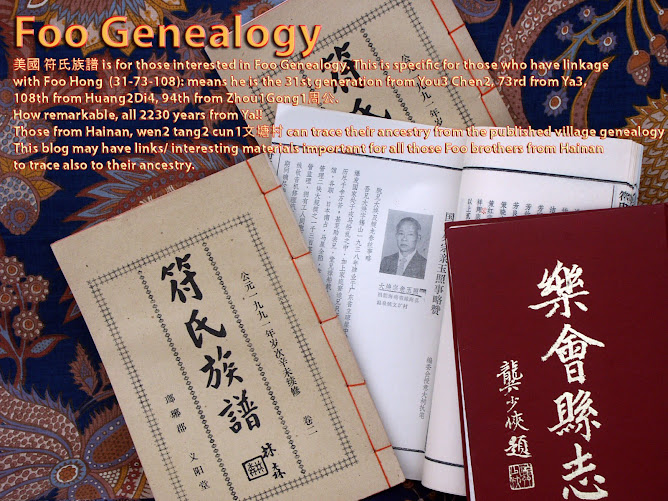
Shi4 Zu2 Pu3.” The Foo clan
genealogical records had been reprinted in 1982 by Foo Tee
Tay (符氏社fu2shi4she4),
our
Clan Temple in Singapore. It was eleven
volumes long and weighed twenty pounds! Since each photocopied page contained
four of the original pages, this reprint was only one quarter of the original
document!
The compilation of this 符氏族谱Fu2 Shi4 Zu2 Pu3 required 603
people and five years of work. From
1933-1938, 符元春
(28-70) (Fu2Yuan2Chun1)[2][2] and 符致逵(30-72)
(Fu2Zhi4Kui2), an Economic professor at Nan Kai University (南開大學Nan2 Kai1 da4xue2), led the project. This
zu2pu3 articulated the links to the Foo clan’s previous zu2pu3s and,
ultimately, to the first generation of Foo (符Fu2), a surname which was created
during the Qin Dynasty (秦Qin2 ).
My father also gave me two
calligraphic zu2pu3s, which begin with the 19th and 28th
generations of Foos after immigrating to海南Hainan respectively. They describe our family history for the past
seventy years and link my children’s generation to the 1938 Fu2 Shi4 Zu2
Pu3. With the information contained in
these genealogical records, we can accurately trace our ancestry for 2,215
years and 75 generations to 符雅Fu2Ya4
and, with some extrapolation, for 3,114 years and 109 generations to 周旦(Zhou1Dan4 ).
My son Farng-Yang Foo (33-75) (符芳揚, Fu2 Fang1Yang2) has also researched our family
history. During his senior year in high
school, he enrolled in an Independent Study class and conducted independent
research on his ethnic identity. His
work has contributed to my understanding of our family history and his unique
approach in addressing our ancestry has reassured me that our family history
will not be lost to future generations.[3][3]
Background
Information
What
is a 族谱zu2pu3
? What is a family temple?
The zu2pu3 is a genealogical
record of a particular clan. It contains
an individual’s name and the names of his wife and sons. It also lists his date of birth and his date
of death, as well as the location of his burial site and the direction that his
tombstone faces. The zu2pu3 records the
individual’s generational and sibling rank as well as the name of the
individual’s father. Similar information
is recorded for each of the individual’s sons.
The zu2pu3 is associated with the
family temple, which is tended by the family’s eldest son. The Chinese place a lot of value in their
family ties. We believe that the
blessings that we have today are a result of the good deeds of our
predecessors. We also believe that our
current actions will affect our future generations. Deceased relatives who are significant
contributors to the family are given a place in the family temple and are
worshipped so that they continue to bless the family. In ancient times, the family temple was
extremely important. Familial
connections were necessary to secure professional opportunities and the temple
and its annual celebrations held at the temple were key in establishing
personal and professional networks.
Those in charge of the temple played pivotal roles in the community.
Whenever someone moved to a new
place and became successful, a new family temple would be established and that
individual would become the first generation of that temple. The new temple
would acknowledge its ties to the previous temple and note its relative
generational rank. Because this system
insured ties to prior family temples and previous family records, future
generations whose fathers and forefathers had followed tradition can easily map
their ancestry.
How
did we obtain the Fu2Shi4Zu2Pu3 符氏族谱,
the Foo clan genealogy?
My father, Foo Hong (31-73) (符大 (永) 焕, Fu2Da4
(Yong3) Huan4), traveled to Hainan, the second
largest island in China, to obtain these records from our relatives and
meticulously traced our lineage within these texts.
The aforementioned “Fu2 Shi4 Zu2
Pu3 符氏族谱”
compiled in 1938 and reprinted in 1982 contains information
about the first zu2pu3 of the Foo family which was compiled around 960 AC,
during the Song dynasty (宋Song4 ), and which contained a preface
written by famous scholar 欧阳修(Ou1
Yang2 Xiu1).
Interestingly enough,
according to the zu2pu3 created in the 1930s, our ancestor 符文章
Fu2Wen2 Zhang1 (17-59) disappeared.
However, one of the calligraphic
zu2pu3s that my father obtained begins with the 19th generation of
Foo, soon after 符正方
Fu2Zheng4Fang1(18-60), 文章Wen2 Zhang1’s son, moved
to a small village, 文山园村(Wen2Shan1Yuan2Cun1). With the exception of my grandfather 符成鋆 Fu2Cheng2Yun2
( 30-72) who migrated to Malaysia, the
descendents of 符正方
Fu2Zheng4Fang1(18-60)
have
lived in this area ever since. The
Foo
Clan Temple, 温泉公社
(Wen1Quan2Gong1She4), is still
located in 文山园村(Wen2Shan1Yuan2Cun1) but the name of the
village has changed to 文塘村(Wen2Tang2Cun1). It houses the current calligraphic zu2pu3
which begins with 符名节Fu2Ming2Jie2 (28-70).
How
do generation names tie into this discussion?
One of motivations behind
compiling the Fu2 Shi4 Zu2 Pu3 符氏族谱 during
the 1930s was to clear up the confusion concerning generation names. At the time, there were six main branches of
the Foo family in Hainan and each had adopted
its own generational poem. The five
branches agreed on the necessity of having one 连谱lian2pu3 and adopted a new 40-word poem with which to name
their offspring.
Chinese names typically consist
of three one-syllable words: the surname, the generation name and the
individual’s personal name. [4][4] For example, my son’s name is 符芳揚Fu2 Fang1Yang2. Fu2 is his surname.
Fang1 is his generation name. 揚Yang2 is his personal name. Someone who is familiar with the Foo family’s
generation poem would know that芳揚Fang1Yang2 is of the 33-75
generation since all the offspring of the 33-75 generation have the generation
name Fang1.[5][5] The 40 words in the Foo family generation
poem are all different so there is no
duplication between generations.
In picking the personal names of
my children, I also utilized a poem.
Their names are揚永遠怡 Yang2Yeong3Yuan3Yi2
which loosely translates to “spreading forever in time and space, the
happiness.” Since 芳 Fang1 means “pleasant” and
“fragrant” and “good” in reference to “name” and “deeds,” 芳揚Fang1Yang2
translates “to make known” or “to spread good deeds.”
芳永Fang1Yeong3
translates to “pleasant and fragrant, good deeds forever in time.” 芳遠 Fang1Yuan3 means “pleasant and
fragrant, good deeds spread far in space” and 芳怡Fang1Yi2 means “pleasant and
fragrant, good deeds and happiness.” The
linguistic ties that I created between my children’s names speaks to my desire
for them to maintain close bonds, to work together and to support each other in
being successful and contributing to society.
OUR
ANCESTERS
The
符
Fu2 Family
According to the Fu2Shi4Zu2 Pu3 符氏族谱, 雅 (0-1) (Ya3) was given the
surname Foo (符 Fu2)
by 秦始皇
Qin2Si3Huang1,
the first emperor of the Qin Dynasty (秦Qin2)
(221-207 BC). The
Emperor gave him the surname Foo (符 Fu2) because of his work governing the royal seals and his subsequent title of 符璽令fu2xi3ling4. 符 雅 (0-1) (Fu2Ya3) was the minister
responsible for the execution of the Emperor’s orders. His original
surname was 姬Ji1
and he was the grandson of 頃公qing3gong1 of
鲁Lu3,
the 34th descendent of 周旦
Zhou1Dan4.[6][6]
Many of the members of the
generations following 符 雅 (0-1) (Fu2 Ya3) were 太守tai4shou3 and 刺史ci4shi3,
which loosely translates as mayors and governors.
符 崇 Fu2Chong2 (0-6) was even named the King of
Qin2 (秦王Qin2Wang2). During the 漢 Han4 dynasty, our ancestor 符融
Fu2Rong2(0-14) was a prominent scholar and served in
the National Academy. During the 唐Tang2 dynasty, 符令奇 Fu2Ling4Qi2 ( 0-33,
782-861 AD) and his eldest son, 符 璘Fu2Lin2 (0-34) were
prominent generals. 符璘Fu2Lin2
was given the title King of 義陽Yi4-Yang2 (義陽郡王Yi4 Yang2 Jun4 Wang2).
The new generation poem of the
Foo Family 聯譜lian2pu3,
literally means to combine or unit the
genealogy, that was adopted in the 1930s begins with a
statement praising 符璘Fu2Lin2 (義陽郡王Yi4 Yang2 Jun4 Wang2). It reads as the following:
義陽標懋績 史策永傳芳 式穀詒謀遠 前徽衍慶長
秉心存孝友 興學育賢良
善繼先人志 文章蔚國光
義陽標懋績
King
Yi4Yang4 had outstanding achievement.
史策永傳芳
The history
books have forever recorded his glorious deeds.
The fact that the six branches of the
Foo Family in Hainan decided to begin their unifying generation
poem with 璘Fu2Lin2’s
title demonstrates an active desire to honor him. It testifies to his prior success and to the
significant contribution he made in our family’s history.
During
the Seventh century, the second Emperor of the Tang2 dynasty ranked the most
influential families of China and符Fu2
was included in the 甲乙姓jia3yi2xing4,
i.e. Number One and Two Surnames.
The next important phase in Foo
family history was during the 五代wu3dai4, the Five Dynasties Period
(906-960 AD), which was one of the most turbulent and exciting periods in the
history of China. Over a span of 54
years, five different dynasties rose to and fell from power. Our ancestor符 存審 Fu2Cun2Shen3
(0-39) was able to maintain his general position through hundreds of battles
and was appointed Manager of Calvary and
Soldiers, 馬步總管ma3bu4zong3guan3. Posthumously, he was awarded the titles of military
governor ( 節度史 jie2du4shi3) and high officer (尚書令shang4shu1lin4).
His nine sons were
famous generals, especially his fourth son, 符彥卿Fu2Yan4Qing1 (0-40, 897-975
AD). He maintained his position through
the tumultuous rise and fall of dynasties and was infamous among the Barbarians
from the West. A common colloquial
phrase that they would use even in response to dealing with their sick horses
would be “ Is king 彥卿Yan4Qing1
responsible for this too?” 彥卿Yan4Qing1 was
awarded many royal titles, including King of Wei (魏王Wei4Wang2).
彥卿Yan4Qing1’s descendents were also very prominent. Many of his sons became generals and three of
his daughters became empresses. The
first daughter was empress of the 世宗Shi4Zong1 of 後周Hou4Zhou1
dynasty. His second daughter was also the wife of 世宗Shi4Zong1 She governed the country with 宗訓Zong1Xun4,
her son
who became emperor at seven years old.[7][7]
She later was named 西宮太后 Xi1Gong1Tai4Hou4, Grand Empress
of the West Court by 太 祖tai4zu3 of 宋song4, who overthrown the Hou4
Zhou1 dynasty.
彥卿Yan4Qing1’s sixth daughter married 宋太宗Song4Tai4Zong1 before
he became the second emperor of the Song4 dynasty (960-1278 AD). When 宋太宗Song4Tai4Zong1
became the King of Jin4 (晉王jin4wang2), she was given the title, Lady
of Yue4, 越國夫人Yue4Guo3Fu1Ren2. Unfortunately, she died at the age of 34,
before her husband became emperor. When
he rose to power, she was given the title the Empress of Exemplary Virtue (懿德 皇后 Yi4De2Huang2Hou4) posthumously.
During the Song dynasty (宋Song4 ),
four Foo generals were sent to govern Hainan Island, the second
largest island in China. One of them was 符有辰Fu2 You3 Chen2(1-42). In
1205 AD, he migrated to this southern island.
Due to his effectiveness in governing the island, he was given the title
the Nobleman who Received Taxes from 10,000 Peasants ( 萬戶侯wan4hu4hou2). His four sons were also generals. The third one , 符宗舉 Fu2Zong1Ju3 (2-44) was so well-respected that after he died he
was worshiped as a god by the natives.
During the 1930s, my grandfather,
符成鋆
Fu2Cheng2Yun2
( 30-72) moved to Malaysia and, during the 1950s, my father moved my mother, my
siblings and me to Brunei Darussalam. The Foo family
continues to prosper on Hainan
Island and, to this day,
plays a prominent role on the Island.
Moving to Hainan
was a mixed blessing for the Foo family.
Departure from the mainland ensured our prosperity but at the same time,
it deprived us of the opportunity to play a major role in subsequent Chinese
history. Because of this break from the
mainland, the Foo family is able to trace its roots with ease. Most likely, any Chinese individual you meet
with the 符Fu2
surname is from Hainan Island.
I wonder what happened to the
Foos who remained in mainland China. About 800 years and about 32 generations have
passed. Since only a few of our
relatives went to Hainan
Island to govern, the
majority still lived in mainland China. Therefore, it seems likely that the Foo
descendents in mainland China
would currently outnumber the Foo descendents on the island. Why aren’t there many Foos in mainland China? Were the Foos who remained in the mainland
killed? Did they change their name to avoid prosecution from subsequent Western
invasions? If so, what other names did they adopt?[8][8]
The Liew
(劉 Liu2)
Family
Although it may seem
unconventional to bring up my wife’s lineage in a discussion about the Foo
family history, I believe that it is important for my children to know about
their mother’s family as well as my own.
In addition to interviewing my father
and examining the laws and moral teachings of the Foo family, in his high
school Independent Study, my son Farng-Yang Foo (33-75) (符芳揚, Fu2Fang1Yang2) investigated his mother’s family
history. He included the latter
information in a high school paper he wrote entitled “My Mom’s Side.”
My wife Anastatia’s maiden Chinese name
is 劉芝蓮Liu2Zhi1Lian2. She is a direct descendent of the rulers of
the 漢朝Han dynasty (206 BC - 220
AD). Her lineage can be traced to the
first four Han dynasty emperors: 高祖gao1zu3
(劉邦Liu2Bang1), emperor Hui2(惠帝Hui2,emperor Wen2(文帝Wen2di4),emperor Jing3(景帝Jing3di4). Her ancestry also
includes the two Emperors of 蜀漢Shu3Han4 (220-280 AD). Her family is able to trace their
ancestry because of a family temple situated in the small village 龍鼓灘Long2Gu3
in 新界Xin1Jie4, also known as New Territory,
Hong Kong. This family temple was
established about five generations ago, before my wife’s grandfather, 劉天帶Liu2Tian1Dai4 immigrated to Brunei Darussalam.
In 1999, when Stephen Liew, my wife’s father, passed away, I traveled with
her and my daughters Farng-Yeong Foo
(33-75) (符 芳永Fu2Fang1Yeong3) and Farng-Yuan Foo
(33-75) (符 芳遠Fu2Fang1Yuan3) to visit the Liew family temple and ensure that they also know
their root from the 劉Liew
family zu2pu3.
CONCLUSION
There are many lessons that can be
learned from the 族譜zu2pu3.
From our ancestors, we know that
success cannot be inherited. It only
“lasts” when successive generations work hard.
There were famous examples in our ancestor struggles. The following
quotes say it all.
将相本无种,男儿当自强
jiang1xiang1ben3wu2zhong4,nan2er2dang1zi4qiang2
Generals and Ministers are not predestined.
Man has to be strong and pursue excellence oneself
Simultaneously, the 族譜zu2pu3
teaches
us to respect the past. There would be
no present without the struggles and hard work of our relatives in the past. I
am grateful that my
family had the resources to set up family temples, let alone to produce such
documents.
Although I feel lucky to live in
such a challenging world and changing time, rapid technical advances make
things feel transient and, sometimes, it seems as if everything is disposable.
The 族譜zu2pu3 is a document that gives me
personal insight into institutional history.
The names and deeds cited in my
discussion of the Foo ancestors were not only derived from the Foo family
zu2pu3s but also listed in the official histories of the Tang and Song
dynasties.
Times have changed. In the past, female offspring were not given
the same generational name as their male siblings. My brothers and I gave all of our children,
both male and female, names from the Foo family generation poem. My father also made sure to write Nin Ho (念豪nian4hao2),
the name of my sister and his only daughter, in the current Foo family族譜zu2pu3.
I wonder what will become of the
Foo Family in the US. With the accuracy of computers and the
convenience of the Internet, it may be easier to track future generations and
it will be interesting to see what happens to the future. Someone who bares the name Foo may have
descendents with last names like Mack, Smith, Jones, Park or Escobar. In the end, our Foo descendents may bear more genetic
resemblance to other non-Foo individuals than to fellow descendents of our
genealogical line. My investigation into
my family history has strengthened my belief that racial differences are more
an issue of perception rather than biological and scientific fact, especially
in this rapid changing age. What is all this fighting we see? The world would be a much better place if we
worked together rather than hurt each other.
These are my thoughts for today. Happy New Year 2004.
Sun-Hoo Foo
(32-74) ( revised January
11, 2004 )
With editorial help from Farng-Yeong Foo (33-75)
The Chinese vocabulary in this document
(GB files)
符氏族谱
雅有辰 文章 鲁顷公 秦始皇黄帝
文山园村 符焕成鋆 芳扬 钰
融 汉 唐朝 令奇 麟 义阳郡王
五代 存审 尚书 节度史
马步 彦卿yan4qing1魏王wei4wang2
后周hou4zhou1世宗shi4zong1
西宫太后
Xi1gong1tai4hou4
宗训zong1xun4 恭帝gong1di4
宋太宗song4tai4zong1 祖zu3国郑王Zheng4wang2
`
晋王jin4wang2
越国夫人yue4guo3fu1ren2懿德yi4de2
甲乙姓jia3yi2xing4 万户侯wan4hu4hou2
宗举 zong1ju3崇chong2
秦王qin2wang2
芳永芳远芳怡扬
汉邦bang1文景惠蜀汉shu3han4
龙鼓滩long2gu3新界xin1jie4 天带tian1dai4
香蕉xiang1jiao1 竹心zhu1xin1
族谱zu2pu3
将相本无种,男儿当自强种儿
元春yuan2chun1 致逵
zhi4kui2
南开nan2
kai1符芝莲zhi1lian2
尚书shang4shu1 a high official in ancient China; minister (in
the Ming and Qing dynasties).
总管zong2guan2 manager.
懿yi4 exemplary.
皇后huang2hou4
周旦 Zhou1Dan4 was the bishop
brother of 武王Emperor
Wu3 Wang2 of the 周Zhou1 Dynasty (1122-255 BC). Emperor 武王Wu3 Wang2’s ancestry can
be traced to黃帝Huang2Ti4 (2697 BC), the first emperor of China.