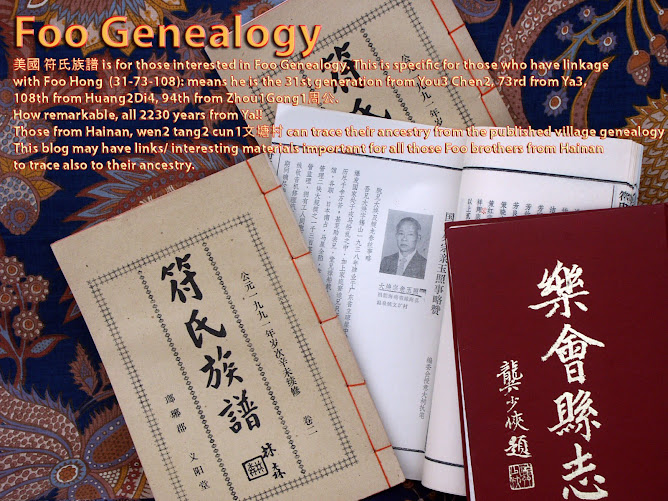
美國 符氏族譜 is for those interested in Foo Genealogy. This is specific for those who have linkage with Foo Hong 大焕 (31-73-108): means he is the 31st generation from 有辰(You3 Chen2), 73rd from 雅(Ya3), 108th from 周公(Zhou1Gong1),120th from 黃帝(Huang2Di4), . How remarkable!!Those from wen2 tang2 cun1文塘村 can trace their ancestry from the published genealogy book of the village. This blog may have links/ interesting materials important for all those Foo brothers from Hainan to trace also to their ancestry.
Showing posts with label meaning of names. Show all posts
Showing posts with label meaning of names. Show all posts
Sunday, June 2, 2013
符氏堂號 Names of Foo Temple
責編:符義勛
符氏的發祥地是"琅琊郡",研究姓氏本源,离不開涉及其發祥地,習慣上把此發祥地稱為"郡望"、或者叫做"堂號"。堂號是一個姓氏的特殊標識,它能顯示姓氏發源的地源關系。在家譜中,堂號具有聯系姓氏与宗族關系的意義,也是后代尋根問祖的重要線索之一。堂號名稱的出處有兩种,一种取自郡號名,一种為家族中人自創名。一般地說,堂號多取自于郡號名。郡是秦、漢時期對行政區域的建置,郡號名又取自于郡名,或諸侯國名,地方府、州、縣名。隨著姓氏家族的發展壯大,就出現了以各姓氏名門望族發祥地的郡號名作為堂號的由來。因此符氏的堂號是"琅琊堂"。
大家族日久人眾,或是遇到天災連年之時,族人就會因遷徙流离,而散布各地,于是就有了在"總堂號"之下,再加入"分堂號"的方法加以區別而便于傳承。"總堂號"代表其發祥地,寓后人不忘根本。"分堂號"則是族人遷徙至新地,成為當地有名望的家族后,以該地的郡號作為堂號。"總堂號"和"分堂號" 統稱為"郡望"。
符氏因雅公后代世居琅琊郡(位于今山東省青島市膠南縣琅琊鄉),故琅琊實為符氏發祥地,后人則以琅琊郡為符氏的總堂號。春秋時期該地是繁華的大商港及水師基地,越王勾踐以之為國。秦始皇統一天下后置行政區為四十郡,琅琊郡是其一。后因唐代安祿山叛亂時,公雅三十四世孫璘公,任台子詹事御史中丞輔國大將軍等職,在河南陳州宛邱,因會同顏真卿平息叛亂有功,而被封為義陽郡王,故符氏又增加了"義陽堂"這個分堂號。海南符氏大多數屬于義陽堂的后裔。除此之外,在全國各地古老的《符氏族譜》中還可發現像湖南的"眘笽堂""、"敦本堂"和浙江的"顯承堂"等分堂號。堂號是氏族后代尋根問祖的有效途徑之一,在符氏里推廣堂號方便大家是有必要的。
茲錄堂號如下:
①符雅祖籍為琅琊、西漢至隋唐其后人在山東臨沂、諸城、膠南等地衍為望族,這些地方過去屬琅琊郡,所 以散居于各地的符氏人家,為了紀念祖先的出處,世代沿用"琅琊"堂號,乃有"琅琊堂"。
②唐代臨沂后人符麟為輔國大將軍,在河南淮陽封為義陽郡王,其后淮陽人符存審為宣武節度使,歷經百戰不敗,其子符彥卿拜太傅,封魏王,加封太師,彥卿三女皆為二朝皇后,彥卿之兄皆為節度使,形成一個武將家庭,符氏家族因此在宋初成為顯赫一時的大家族,符氏后人又多封官撫邊,其后逐漸向海外發展,分布于世界各地,居住于東南亞的符氏后人便以"義陽"為堂號,遂有"義陽堂"之堂號來紀念先祖符璘將軍,目前"義陽堂"支乃是符氏最大人口之族群 。
③ 符雅的后人遷居蘇南,又有"積善堂"。
(4) 另有一支符氏為"忠厚堂"。
(5)湖南湘西符融后人為"??堂"。
(6)浙江宁波余姚一支為"顯承堂"。
(7)浙江衢州一支符氏后人為"明遠堂"。
(8)湖南長沙符氏一支為"敦本堂"。
(9)江西南昌灣里區符氏后人為"崇禮堂"。
(10)福建、蘇北符氏后人為"繩武堂"。
(11)江蘇無錫現重修家譜,堂名為"任德堂"
(12)山東菏澤鄆城符氏為"志遠堂"。。
(13)江西吉安永丰符氏"啟順堂"。
(14)符氏一支為"昌榮堂"。
(15)江蘇丹陽重修家譜,堂名為"榖貽堂"。
(16)江蘇常州現重修家譜,堂名"优然堂"
(17)川東達川符氏為"報本堂"。
(18)安徽蚌埠怀遠符氏為"樂施堂"。
(19)山西紅桐符氏移民為"惠民堂"。
(20)湖南衡山符氏--甘霖堂
(21)江西婺源縣北龍溪村為"紹源堂"、"四維堂"。
(22)陝西"琅琊堂"
(23)江西南昌灣里"崇禮堂"。
(24)江西宁都"京兆堂"。
(25)安徽濡潛(廬江無為)符氏"明德堂"。
以上僅知道符氏的20多個堂號,肯定還有不少遺漏,望知道的宗親提供信息,以便完善。
歡迎本家提供堂號,堂號地點,始遷祖及輩份詩歌。
符氏堂號 1、符姓始祖雅公祖籍為魯琅琊、周秦仕符璽令,因官得姓,因而成為陝西姓,西漢至隋唐其后人因職自陝遷回山東臨沂、諸城、膠南等地衍為望族,這些地方過去屬琅琊郡,故散居于各地的符氏后代,為了紀念祖先的出處,世代沿用"琅琊"堂號,乃有"琅琊堂"。 2、唐代臨沂后人符璘為輔國大將軍,奔馳中原沙場,因功受封為義陽郡王,后人唐末遷陳州宛丘,五代有秦王符存審,宣武節度使,歷百戰不敗,其四子符彥卿官拜太傅,封魏王,加封太師,魏王符彥卿三女為二朝皇后,包括符彥卿內之九兄弟皆為節度使將領,形成武將世家,符氏家族因此在北宋成為顯赫一時的皇朝外戚大家族,符氏后裔又多封官撫邊,其后逐漸向他省發展,居住于海南, 東南亞及歐美的后代多是符璘后裔。自義陽郡王符璘后裔南雄太守符元生唐末年間奉命遷職海南后,遂有"義陽堂"之堂號紀念先祖符璘將軍,目前"義陽堂"支乃是符氏最大人口之族群 。
符氏郡望: 琅琊
1. 山東 "琅琊堂"
2. 山東鄆城 ""志遠堂"
3. 安徽蚌阜"樂施堂"又名"玉璽堂"
4. 海南"義陽堂"
5. 蘇南"積善堂"
6. 蘇南"忠厚堂"
7. 蘇南無錫"任德堂"
8. 蘇北泰州"繩武堂"
9. 湖南湘西"眘笽堂"
10. 湖南麻陽"琅琊堂"、"顯承堂" (摘自湖南麻陽符氏源流)
11. 湖南長沙" 敦本堂"
12. 浙江余姚"顯承堂"
13. 浙江宁波"顯承堂"
14. 浙江"明遠堂"
15. 浙江衢州"明遠堂"
16. 陝西"琅琊堂"
17. 江蘇丹陽"谷詒堂"
18. 江蘇無錫"任德堂"
19. 江蘇武進"优然堂"
20. 江西南昌灣里"崇禮堂"
21. 江西宁都"京兆堂"
22. 江西廣昌"京兆堂"
23. 江西永丰"京兆堂"
24. 江西興國"京兆堂"
25. 江西吉安"啟順堂"
26. 江西余干"???堂"
27. 江西玉山"???堂"
28. 江西新余"???堂"
29. 江西新建"??堂"
30. 江西丰域"??堂"
31. 江西宜黃"??堂"
32. 山西洪桐"惠民堂"
33. 廣西博白"追遠堂"

Monday, November 9, 2009
Foo Clan Genealogy
Introduction
My study of the Foo family history began in 1984. My wife and I took our children to visit Brunei Darussalam, the Southeast Asian country where we had grew up and where our relatives still reside. It was at this time that my father, Foo Hong (31-73) (符大(永)焕 Fu2Da4 (Yong3) Huan4), handed me the "符氏族谱 Fu2 Shi4 Zu2 Pu3." The Foo clan genealogical records had been reprinted in 1982 by Foo Tee Tay (符氏社fu2shi4she4), our Clan Temple in Singapore. It was eleven volumes long and weighed twenty pounds! Since each photocopied page contained four of the original pages, this reprint was only one quarter of the original document!
The compilation of this 符氏族谱Fu2 Shi4 Zu2 Pu3 required 603 people and five years of work. From 1933-1938, 符元春 (28-70) (Fu2Yuan2Chun1)[2] and 符致逵(30-72) (Fu2Zhi4Kui2), an Economic professor at Nan Kai University (南開大學Nan2 Kai1 da4xue2), led the project.
This zu2pu3 articulated the links to the Foo clan's previous zu2pu3s and, ultimately, to the first generation of Foo (符Fu2), a surname which was created during the Qin Dynasty (秦Qin2 ).
My father also gave me two calligraphic zu2pu3s, which begin with the 19th and 28th generations of Foos after immigrating to海南Hainan respectively. They describe our family history for the past seventy years and link my children's generation to the 1938 Fu2 Shi4 Zu2 Pu3. With the information contained in these genealogical records, we can accurately trace our ancestry for 2,215 years and 75 generations to 符雅Fu2Ya4 and, with some extrapolation, for 3,114 years and 109 generations to 周旦(Zhou1Dan4 ).
My son Farng-Yang Foo (33-75) (符芳揚, Fu2 Fang1Yang2) has also researched our family history. During his senior year in high school, he enrolled in an Independent Study class and conducted independent research on his ethnic identity. His work has contributed to my understanding of our family history and his unique approach in addressing our ancestry has reassured me that our family history will not be lost to future generations.[3]
Background Information
What is a 族谱zu2pu3 ? What is a family temple?
The zu2pu3 is a genealogical record of a particular clan. It contains an individual's name and the names of his wife and sons. It also lists his date of birth and his date of death, as well as the location of his burial site and the direction that his tombstone faces. The zu2pu3 records the individual's generational and sibling rank as well as the name of the individual's father. Similar information is recorded for each of the individual's sons.
The zu2pu3 is associated with the family temple, which is tended by the family's eldest son. The Chinese place a lot of value in their family ties. We believe that the blessings that we have today are a result of the good deeds of our predecessors. We also believe that our current actions will affect our future generations. Deceased relatives who are significant contributors to the family are given a place in the family temple and are worshipped so that they continue to bless the family. In ancient times, the family temple was extremely important. Familial connections were necessary to secure professional opportunities and the temple and its annual celebrations held at the temple were key in establishing personal and professional networks. Those in charge of the temple played pivotal roles in the community.
Whenever someone moved to a new place and became successful, a new family temple would be established and that individual would become the first generation of that temple. The new temple would acknowledge its ties to the previous temple and note its relative generational rank. Because this system insured ties to prior family temples and previous family records, future generations whose fathers and forefathers had followed tradition can easily map their ancestry.
How did we obtain the Fu2Shi4Zu2Pu3 符氏族谱, the Foo clan genealogy?
My father, Foo Hong (31-73) (符大 (永) 焕, Fu2Da4 (Yong3) Huan4), traveled to Hainan, the second largest island in China, to obtain these records from our relatives and meticulously traced our lineage within these texts.
The aforementioned "Fu2 Shi4 Zu2 Pu3 符氏族谱" compiled in 1938 and reprinted in 1982 contains information about the first zu2pu3 of the Foo family which was compiled around 960 AC, during the Song dynasty (宋Song4 ), and which contained a preface written by famous scholar 欧阳修(Ou1 Yang2 Xiu1).
Interestingly enough, according to the zu2pu3 created in the 1930s, our ancestor 符文章 Fu2Wen2 Zhang1 (17-59) disappeared. However, one of the calligraphic zu2pu3s that my father obtained begins with the 19th generation of Foo, soon after 符正方 Fu2Zheng4Fang1(18-60),
文章Wen2 Zhang1's son, moved to a small village, 文山园村(Wen2Shan1Yuan2Cun1). With the exception of my grandfather 符成鋆 Fu2Cheng2Yun2 ( 30-72) who migrated to Malaysia, the descendents of 符正方 Fu2Zheng4Fang1(18-60) have lived in this area ever since. The Foo Clan Temple, 温泉公社 (Wen1Quan2Gong1She4), is still located in 文山园村(Wen2Shan1Yuan2Cun1) but the name of the village has changed to 文塘村(Wen2Tang2Cun1). It houses the current calligraphic zu2pu3 which begins with 符名节Fu2Ming2Jie2 (28-70).
How do generation names tie into this discussion?
One of motivations behind compiling the Fu2 Shi4 Zu2 Pu3 符氏族谱 during the 1930s was to clear up the confusion concerning generation names. At the time, there were six main branches of the Foo family in Hainan and each had adopted its own generational poem. The five branches agreed on the necessity of having one 连谱lian2pu3 and adopted
a new 40-word poem with which to name their offspring.
Chinese names typically consist of three one-syllable words: the surname, the generation name and the individual's personal name. [4] For example, my son's name is 符芳揚Fu2 Fang1Yang2. Fu2 is his surname. Fang1 is his generation name. 揚Yang2 is his personal name. Someone who is familiar with the Foo family's generation poem would know that芳揚Fang1Yang2 is of the 33-75 generation since all the offspring of the 33-75 generation have the generation name Fang1.[5] The 40 words in the Foo family generation poem
are all different so there is no duplication between generations.
In picking the personal names of my children, I also utilized a poem. Their names are揚永遠怡
Yang2Yeong3Yuan3Yi2 which loosely translates to "spreading forever in time and space, the happiness." Since 芳 Fang1 means "pleasant" and "fragrant" and "good" in reference to "name" and "deeds," 芳揚Fang1Yang2 translates "to make known" or "to spread good deeds." 芳永Fang1Yeong3 translates to "pleasant and fragrant, good deeds forever in time." 芳遠 Fang1Yuan3 means "pleasant and fragrant, good deeds spread far in space" and 芳怡Fang1Yi2 means "pleasant and fragrant, good deeds and happiness." The linguistic ties that I created between my children's names speaks to my desire for them to maintain close bonds, to work together and to support each other in being successful and contributing to society.
OUR ANCESTERS
The 符 Fu2 Family
According to the Fu2Shi4Zu2 Pu3 符氏族谱, 雅 (0-1) (Ya3) was given the surname Foo (符 Fu2) by 秦始皇 Qin2Si3Huang1, the first emperor of the Qin Dynasty (秦Qin2) (221-207 BC). The Emperor gave him the surname Foo (符 Fu2) because of his work governing the royal seals and his subsequent title of 符璽令fu2xi3ling4.
符
雅 (0-1) (Fu2Ya3) was the minister responsible for the execution of the Emperor's orders.
His original surname was 姬Ji1 and he was the grandson of 頃公qing3gong1 of 鲁Lu3, the 34th descendent of 周旦 Zhou1Dan4.[6]
Many of the members of the generations following 符
雅 (0-1) (Fu2 Ya3) were 太守tai4shou3 and 刺史ci4shi3, which loosely translates as mayors and governors. 符
崇 Fu2Chong2 (0-6) was even named the King of Qin2 (秦王Qin2Wang2). During the 漢 Han4 dynasty, our ancestor 符融 Fu2Rong2(0-14) was a prominent scholar and served in the National Academy. During the 唐Tang2 dynasty, 符令奇 Fu2Ling4Qi2 ( 0-33, 782-861 AD) and his eldest son, 符
璘Fu2Lin2 (0-34) were prominent generals. 符璘Fu2Lin2 was given the title
King of 義陽Yi4-Yang2 (義陽郡王Yi4 Yang2 Jun4 Wang2).
The new generation poem of the Foo Family 聯譜lian2pu3, literally means to combine or unit the genealogy, that was adopted in the 1930s begins with a statement praising 符璘Fu2Lin2 (義陽郡王Yi4 Yang2 Jun4 Wang2). It reads as the following:
義陽標懋績
史策永傳芳
式穀詒謀遠
前徽衍慶長
秉心存孝友
興學育賢良
善繼先人志
文章蔚國光
義陽標懋績
King Yi4Yang4 had outstanding achievement.
史策永傳芳
The history books have forever recorded his glorious deeds.
The fact that the six branches of the Foo Family in Hainan decided to begin their unifying generation poem
with 璘Fu2Lin2's title demonstrates an active desire to honor him. It testifies to his prior success and to the significant contribution he made in our family's history.
During the Seventh century, the second Emperor of the Tang2 dynasty ranked the most influential families of China and符Fu2 was included in the 甲乙姓jia3yi2xing4, i.e. Number One and Two Surnames.
The next important phase in Foo family history was during the 五代wu3dai4, the Five Dynasties Period (906-960 AD), which was one of the most turbulent and exciting periods in the history of China. Over a span of 54 years, five different dynasties rose to and fell from power. Our ancestor符
存審 Fu2Cun2Shen3 (0-39) was able to maintain his general position through hundreds of battles and was appointed Manager of Calvary and Soldiers, 馬步總管ma3bu4zong3guan3. Posthumously, he was awarded the titles of military governor ( 節度史 jie2du4shi3) and high officer (尚書令shang4shu1lin4).
His nine sons were famous generals, especially his fourth son, 符彥卿Fu2Yan4Qing1 (0-40, 897-975 AD). He maintained his position through the tumultuous rise and fall of dynasties and was infamous among the Barbarians from the West. A common colloquial phrase that they would use even in response to dealing with their sick horses would be " Is king 彥卿Yan4Qing1 responsible for this too?" 彥卿Yan4Qing1 was awarded many royal titles, including King of Wei (魏王Wei4Wang2).
彥卿Yan4Qing1's descendents were also very prominent. Many of his sons became generals and three of his daughters became empresses. The first daughter was empress of the 世宗Shi4Zong1 of 後周Hou4Zhou1 dynasty. His second daughter was also the wife of 世宗Shi4Zong1 She governed the country with 宗訓Zong1Xun4, her son who became emperor at seven years old.[7]
She later was named
西宮太后 Xi1Gong1Tai4Hou4, Grand Empress of the West Court by 太 祖tai4zu3 of 宋song4, who overthrown the Hou4 Zhou1 dynasty.
彥卿Yan4Qing1's sixth daughter married 宋太宗Song4Tai4Zong1 before he became the second emperor of the Song4 dynasty (960-1278 AD). When 宋太宗Song4Tai4Zong1 became the King of Jin4 (晉王jin4wang2), she was given the title, Lady of Yue4, 越國夫人Yue4Guo3Fu1Ren2. Unfortunately, she died at the age of 34, before her husband became emperor. When he rose to power, she was given the title the Empress of Exemplary Virtue (懿德 皇后 Yi4De2Huang2Hou4) posthumously.
During the Song dynasty (宋Song4 ), four Foo generals were sent to govern Hainan Island, the second largest island in China. One of them was 符有辰Fu2 You3 Chen2(1-42). In 1205 AD, he migrated to this southern island. Due to his effectiveness in governing the island, he was given the title the Nobleman who Received Taxes from 10,000 Peasants ( 萬戶侯wan4hu4hou2). His four sons were also generals. The third one , 符宗舉 Fu2Zong1Ju3 (2-44) was so well-respected that after he died he was worshiped as a god by the natives.
During the 1930s, my grandfather, 符成鋆 Fu2Cheng2Yun2 ( 30-72) moved to Malaysia and, during the 1950s, my father moved my mother, my siblings and me to Brunei Darussalam. The Foo family continues to prosper on Hainan Island and, to this day, plays a prominent role on the Island.
Moving to Hainan was a mixed blessing for the Foo family. Departure from the mainland ensured our prosperity but at the same time, it deprived us of the opportunity to play a major role in subsequent Chinese history. Because of this break from the mainland, the Foo family is able to trace its roots with ease. Most likely, any Chinese individual you meet with the 符Fu2 surname is from Hainan Island.
I wonder what happened to the Foos who remained in mainland China. About 800 years and about 32 generations have passed. Since only a few of our relatives went to Hainan Island to govern, the majority still lived in mainland China. Therefore, it seems likely that the Foo descendents in mainland China would currently outnumber the Foo descendents on the island. Why aren't there many Foos in mainland China? Were the Foos who remained in the mainland killed? Did they change their name to avoid prosecution from subsequent Western invasions? If so, what other names did they adopt?[8]
The Liew (劉 Liu2) Family
Although it may seem unconventional to bring up my wife's lineage in a discussion about the Foo family history, I believe that it is important for my children to know about their mother's family as well as my own. In addition to interviewing my father and examining the laws and moral teachings of the Foo family, in his high school Independent Study, my son Farng-Yang Foo (33-75) (符芳揚, Fu2Fang1Yang2) investigated his mother's family history. He included the latter information in a high school paper he wrote entitled "My Mom's Side."
My wife Anastatia's maiden Chinese name is 劉芝蓮Liu2Zhi1Lian2. She is a direct descendent of the rulers of the 漢朝Han dynasty (206 BC - 220 AD). Her lineage can be traced to the first four Han dynasty emperors: 高祖gao1zu3 (劉邦Liu2Bang1), emperor Hui2(惠帝Hui2,emperor Wen2(文帝Wen2di4),emperor Jing3(景帝Jing3di4). Her ancestry also includes the two Emperors of 蜀漢Shu3Han4 (220-280 AD). Her family is able to trace their ancestry because of a family temple situated in the small village 龍鼓灘Long2Gu3 in 新界Xin1Jie4, also known as New Territory, Hong Kong. This family temple was established about five generations ago, before my wife's grandfather, 劉天帶Liu2Tian1Dai4 immigrated to Brunei Darussalam.
In 1999, when Stephen Liew, my wife's father, passed away, I traveled with her and my daughters Farng-Yeong Foo (33-75) (符
芳永Fu2Fang1Yeong3) and Farng-Yuan Foo (33-75) (符
芳遠Fu2Fang1Yuan3) to visit the Liew family temple and ensure that they also know their root from the 劉Liew family zu2pu3.
CONCLUSION
There are many lessons that can be learned from the 族譜zu2pu3.
From our ancestors, we know that success cannot be inherited. It only "lasts" when successive generations work hard. There were famous examples in our ancestor struggles. The following quotes say it all.
将相本无种,男儿当自强
jiang1xiang1ben3wu2zhong4,nan2er2dang1zi4qiang2
Generals and Ministers are not predestined.
Man has to be strong and pursue excellence oneself
Simultaneously, the 族譜zu2pu3 teaches us to respect the past. There would be no present without the struggles and hard work of our relatives in the past. I am grateful that my family had the resources to set up family temples, let alone to produce such documents.
Although I feel lucky to live in such a challenging world and changing time, rapid technical advances make things feel transient and, sometimes, it seems as if everything is disposable. The 族譜zu2pu3 is a document that gives me personal insight into institutional history. The names and deeds cited in my discussion of the Foo ancestors were not only derived from the Foo family zu2pu3s but also listed in the official histories of the Tang and Song dynasties.
Times have changed. In the past, female offspring were not given the same generational name as their male siblings. My brothers and I gave all of our children, both male and female, names from the Foo family generation poem. My father also made sure to write Nin Ho (念豪nian4hao2), the name of my sister and his only daughter, in the current Foo family族譜zu2pu3.
I wonder what will become of the Foo Family in the US. With the accuracy of computers and the convenience of the Internet, it may be easier to track future generations and it will be interesting to see what happens to the future. Someone who bares the name Foo may have descendents with last names like Mack, Smith, Jones, Park or Escobar. In the end, our Foo descendents may bear more genetic resemblance to other non-Foo individuals than to fellow descendents of our genealogical line. My investigation into my family history has strengthened my belief that racial differences are more an issue of perception rather than biological and scientific fact, especially in this rapid changing age. What is all this fighting we see? The world would be a much better place if we worked together rather than hurt each other.
These are my thoughts for today. Happy New Year 2004.
Sun-Hoo Foo (32-74) ( revised January 11, 2004 ) With editorial help from Farng-Yeong Foo (33-75)
Saturday, October 10, 2009
Foo Generation Name: old & new
新 派 系
xin1 pai4 xi4
Lists of Foo Generation Names (Middle Name)

New List with Generation Rank*

divisions of old Fu clans **
*Unified Global new Generation Poem Lists of Middle Names for 符 (Fu2). The number denotes the number of generation rank after migrating to海南(Hai3nan2 Dao3 ). e.g. 32傳(chuan2) means 32nd generation to海南島, and 33芳, 33rd generation.
** Comparison of Old and New Lists (Poem) of Middle Names, so that符(Fu2).from 6 different branches( division) can rank themselves in the Ancestry.
New List (Poem) of Generation Names --their pronunciations & meanings:
義 陽 標 懋 績
yi4 yang2 biao1 mao4 ji1
(KING) YI YANG HAD OUTSTANDING ACHIEVEMENT
29 30 31 32 33
史 策 永 傳 芳
shi3 ce4 yong3 chuan2 fang1
HISTORY BOOKS HAVE FOREVER
RECORDED HIS GLORIOUS DEEDS
式 穀 詒 謀 遠
shi4 gu3 yi2 mou2 yuan3
HIS EXAMPLES WILL PASS ON FAR AND BEYOND
前 徽 衍 慶 長
qian2 hui1 yan3 qing4 chang2
THIS PAST GLORY IS CELEBRATED FOR LASTING THIS LONG
秉 心 存 孝 友
bing3 xin1 cun2 xiao4 you3
TO HOLD IN OUR HEART THE PIOUS AND FRIENDLY (KIND HEARTED) VIRTUES
興 學 育 賢 良
xing4 xue2 yu4 xian2 liang2
TO PROMOTE EDUCATION AND NURTURE THE BRIGHT AND GOOD
善 繼 先 人 志
shan4 ji4 xian1 ren2 zhi4
TO GENIALLY CONTINUE AND ADOPT OUR ANCESTORAL ASPIRATION
文 章 蔚 國 光
wen2 zhang1 wei4 guo2guang1
TO SPREAD THESE PHILOSOPHY (WRITINGS) AND BE THE HONOUR OF THE COUNTRY
This new generation names, 5 characters 律诗Lu Shi,
have 40 words total ( 8 lines and 5 characters each) , which will last for 40 generations, and future FOO will gather again when the last character is used to plan for another poems of Foo generation. You may notice that my family did not start with the first character of the poem because after converting to the new system, my corresponding middle name falls on the 9th character of the new generation poem.
傳chuan(32-74) and my children ,芳Fang(33-75) is the 10th character. So our line will have 30 more generations to go.
Chinese name typically start with a Surname(姓), it is similar with western last name but it is first instead of being last, and in our case
Foo (符)
The second name in Chinese is the middle generation name, and is taken from the specific generation poem.
Our new FOO generation poem (五詩律言 lu4shi1, a poem with 5 words and eight lines), indicates the 33rd generation of Foo, after migrating to Hainan is 芳 Fang(33-75). So if one follows the rule and use the new generation poem, one can tell which generation he/she is from the Family tree, just by looking at the middle(generation) name. I put in the second number to denote the generation counting from Ya (雅), who changed his last name to F00 (符) from Emperor Qin.
This system has its disadvantage in the past because the Emperor would execute 5
generations of people related to the criminal of a "major" crime (2 generations above and 2 below). It didn't matter if the other members were children, female, elderly or good. I always wonder, if Foo was so prominent in Sung and Five dynasties, why the majority of Foo only exist in a remote island of Hainan. What happened to those in the main land China?
The last or third name is the person's own name.
So my children's name are 揚,永,遠,怡(33-75)
Foo Farng Yang, 符芳揚
Foo Farng Yeong, 符芳永
Foo Farng Yuan 符芳遠
Foo Farng Yi. 符芳怡
By Sun-Hoo Foo (32-74)
-------------
Subscribe to:
Posts (Atom)